
Marshall City Directory Collections
Marshall city directories survive in several places, but no source inspected for this project confirms one complete local run. The firmest dates are an 1893 example in museum material and a Marshall 1924 volume explicitly listed by the Texas State Library and Archives Commission. Catalog leads add useful possibilities, including a 1912 through 1933 run, selected volumes through 1959, and a 1988-89 Marshall and Karnack directory. Treat the catalog leads as leads to verify before planning a trip or quoting a year. The Marshall Public Library, the museum research center, TSLAC, and partner catalogs are the practical places to ask about a particular edition.
| Collection | Years | Where Held | Access |
|---|---|---|---|
| Marshall city-directory example | 1893 | Harrison County Historical Museum archive context | Ask the museum research center about the volume |
| Marshall city directory | 1924 verified | Texas State Library and Archives Commission | In-library holding |
| Catalog leads | 1912-1933 and selected 1937-1959 dates | Partner and genealogy catalogs | Confirm volume and access before relying on it |
| Marshall and Karnack directory lead | 1988-89 | FamilySearch catalog lead | Check catalog and partner-library availability |
The dates in the table are evidence of individual holdings, not a claim that every intervening year exists or is digitized. A directory volume is a published snapshot. It may miss rural households, people who declined a listing, and residents who arrived after the canvass closed.
Texas State Library and Archives Commission city-directory holdings explicitly list the 1924 Marshall volume.
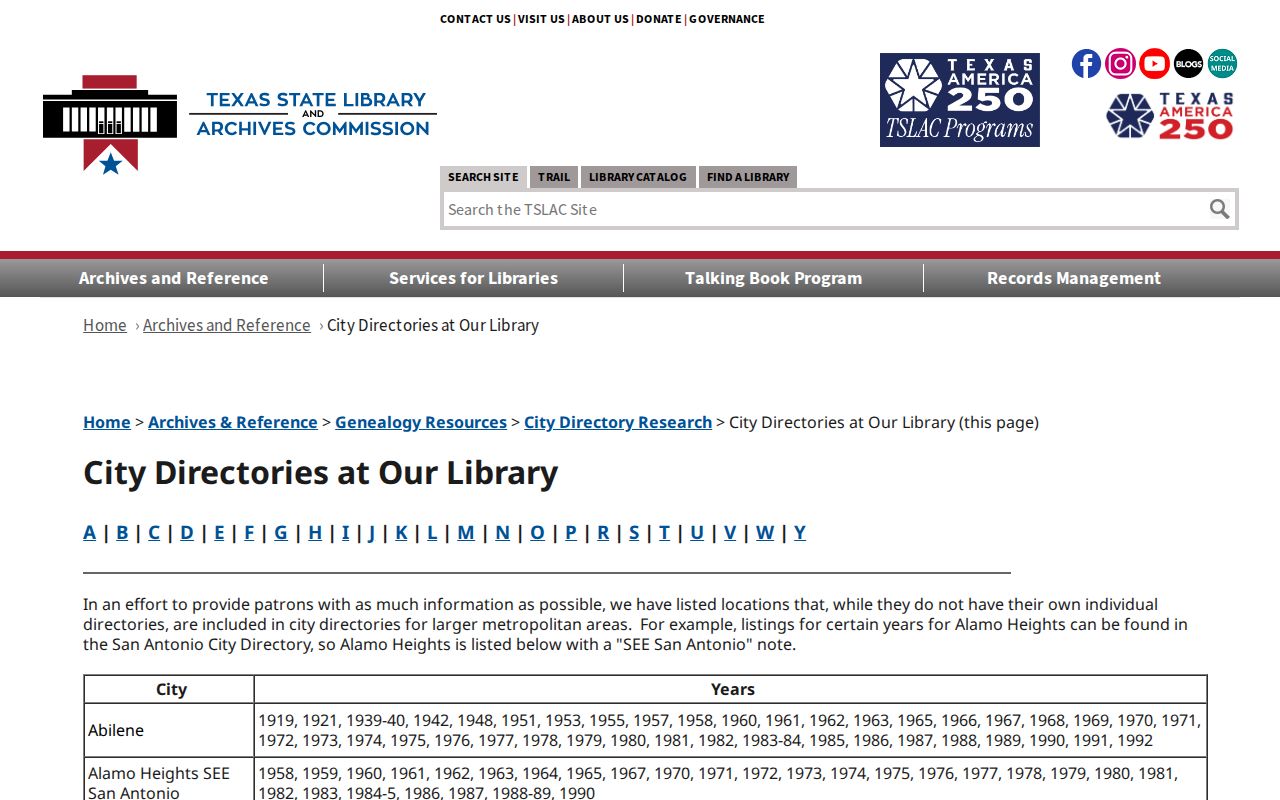
That verified shelf entry gives a dependable starting point when comparing Marshall city-directory catalog leads.
Marshall Directory Catalog Leads
Digitized collections can save a long trip, though an online browse page is not proof that a Marshall scan is available. The Portal to Texas History city-directory collection is a sensible place to inspect by date, and the museum is a Portal partner for local historical material. Search a surname, initials, a street name, and nearby East Texas place names. An image should be read alongside its title page so the edition year and coverage are clear. If a search returns nothing, the volume may be absent, its OCR may be poor, or the household may be unlisted.
The documented access route remains broader than one website: browse the digitized collection, ask Marshall Public Library reference staff, contact the Harrison County Historical Museum research center, and use the TSLAC reading-room and catalog route for state holdings. Library-only Ancestry Library Edition, HeritageQuest through TexShare, and local genealogy resources add research channels without replacing the underlying directory.
The Portal to Texas History city-directory collection provides the digitized browsing route inspected for Marshall research.
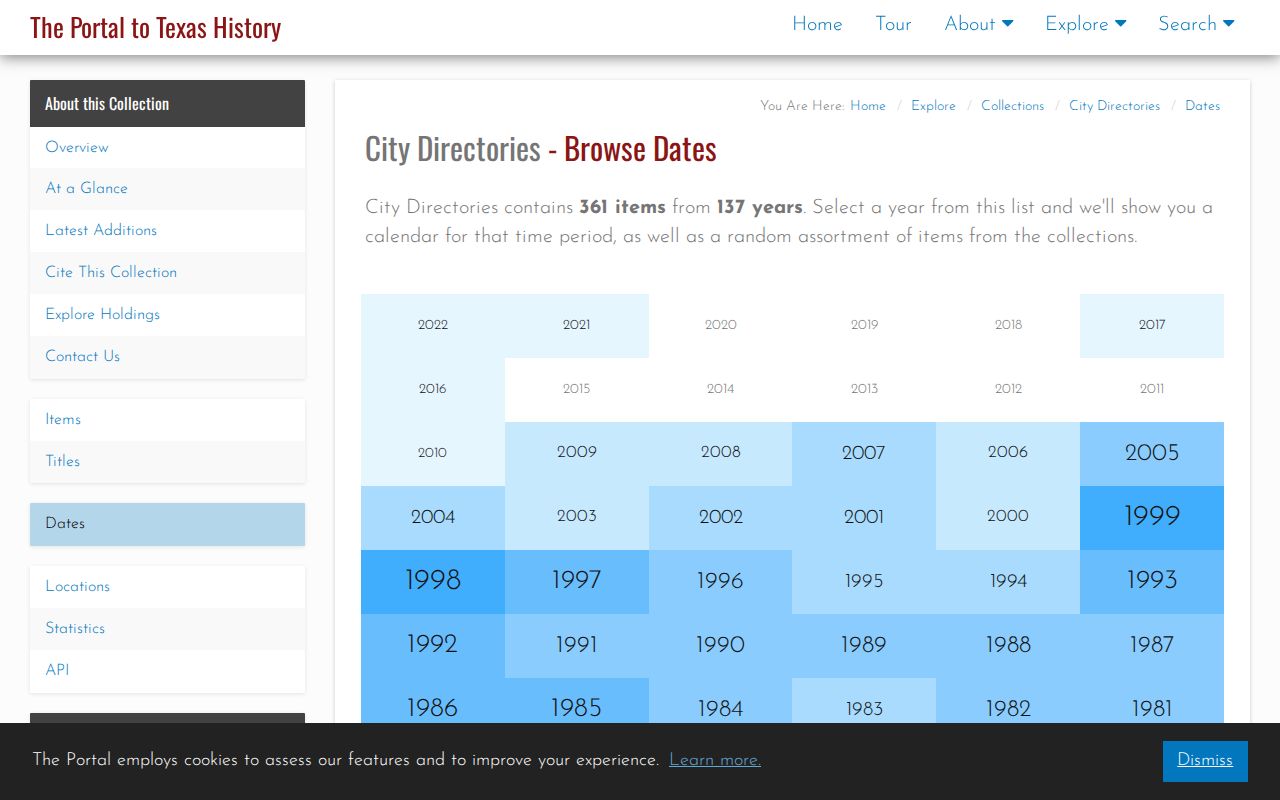
The browse view is useful for checking available scans, while the absence of a visible Marshall item should be treated as a catalog gap rather than proof of no directory.
Marshall Directory Library Desk
Marshall Public Library maintains a permanent Harrison County local-history collection for in-house viewing. Its local-history resources point researchers to books, articles, newspaper archives, HeritageHub, NewsBank, Portal to Texas History, Texas Historical Commission material, and Texas Digital Sanborn Maps through TexShare. The library also directs genealogy research to Ancestry Library Edition inside the library, HeritageQuest, TSLAC resources, and the Harrison County Genealogical Society. Reference assistance is available at 903-935-4465, and the library generally lists Monday through Friday hours of 8:00 a.m. to 5:00 p.m.
Ask specifically whether a volume is a city directory, telephone book, reverse directory, yearbook, or a newspaper clipping file. The web pages do not verify a complete run of each type. A precise request, such as a surname with an approximate decade and street, gives staff a workable search path. For a historic home or family photograph, the library can direct researchers to the museum collection when its own shelf does not reach the question.
Marshall Public Library genealogy resources describe the local research databases and in-library options.
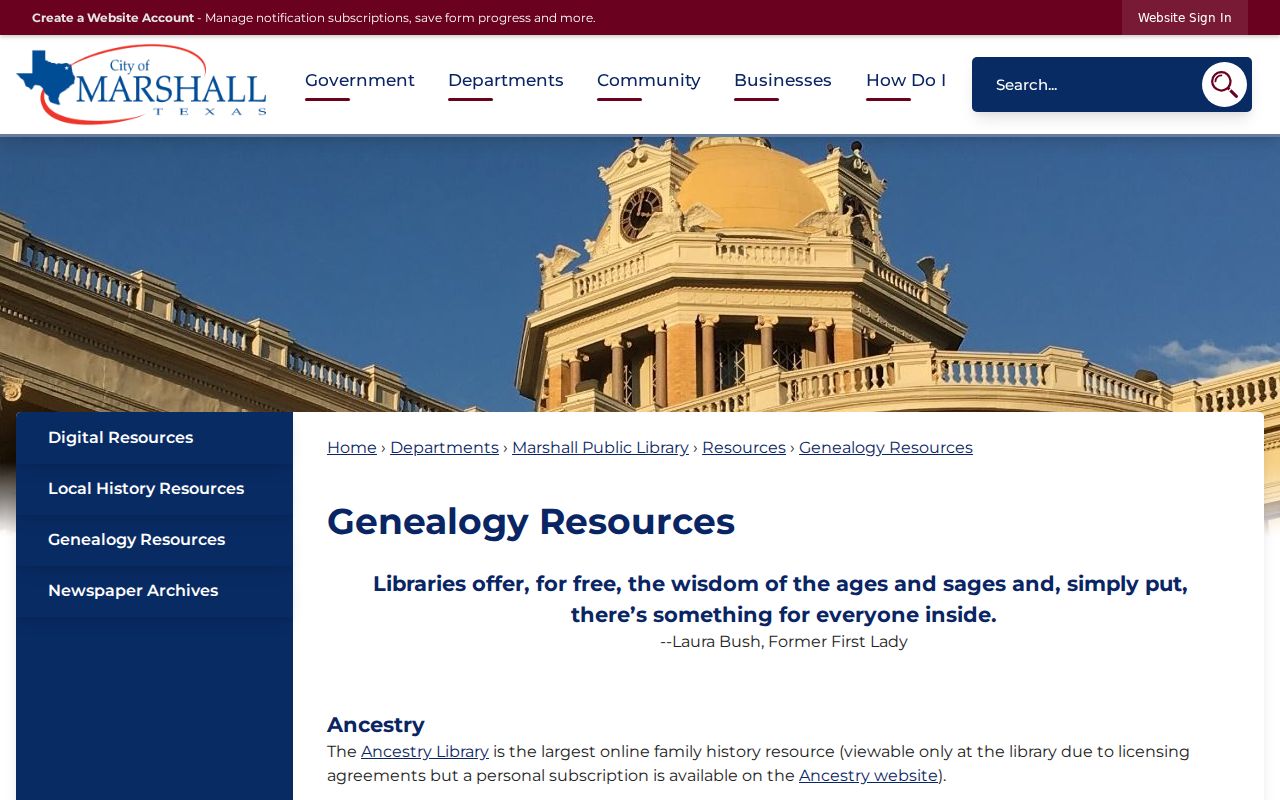
The library route matters because several useful Marshall city-directory companions are available only in person or through library access.
Reading Marshall Directory Marks
A Marshall city directory entry should be transcribed before it is interpreted. The research did not inspect a complete local directory page field by field, so no standardized Marshall entry format is promised here. Start with the title page and abbreviation key. Then record the spelling exactly as printed, the edition year, street number, street name, and any notation around a spouse, widow status, business, or telephone. A listing can establish an association at publication time. It does not establish legal ownership, the makeup of a full household, or present residence.
| Name form | Copy initials, surname spelling, and any variant without silently expanding them. |
|---|---|
| Address | Keep the house number and street together, then compare with historical maps or deed descriptions. |
| Family notation | Parentheses, spouse references, or widow notation can be family-history leads, not proof by themselves. |
| Occupation or institution | Use it only to distinguish similar names or locate related newspaper material. |
| Symbols and abbreviations | Read the volume's own key before deciding what a mark means. |
- Criss-cross directory
- A reverse listing arranged by street and address rather than by surname. A complete Marshall run was not verified.
- Householder index
- A list that organizes a volume around the person named for a home, which may not include every occupant.
- Abbreviation key
- The publisher's explanation of shortened words and marks, usually near the front of the volume and essential for accurate notes.
Note: A city-directory entry is best used with a second dated record before drawing a family or address conclusion.
Marshall Directory Newspaper Checks
Directory gaps can often be tested against local newspapers. Marshall Public Library says Marshall News Messenger archives reach back to 1849, while NewsBank covers 2004 to today and HeritageHub supplies obituary and death-notice research through library resources. Search the printed surname, initials, old street form, and neighboring town names. OCR can miss initials, damaged type, and unusual spelling, so a no-result search is not conclusive. A notice can help bracket a move, marriage, death, business event, or civic appearance that occurs between available directory editions.
Obituaries and newspaper notices are companions to a directory, not substitutes for a vital record or property instrument. They are especially useful at the end of a household trail, when a resident disappears from a later volume. For earlier address context, the library also points to Sanborn maps through TexShare, although no authoritative Marshall map-year list was located in the inspection.
Marshall Public Library local-history resources identify the newspaper, obituary, map, and archive channels.
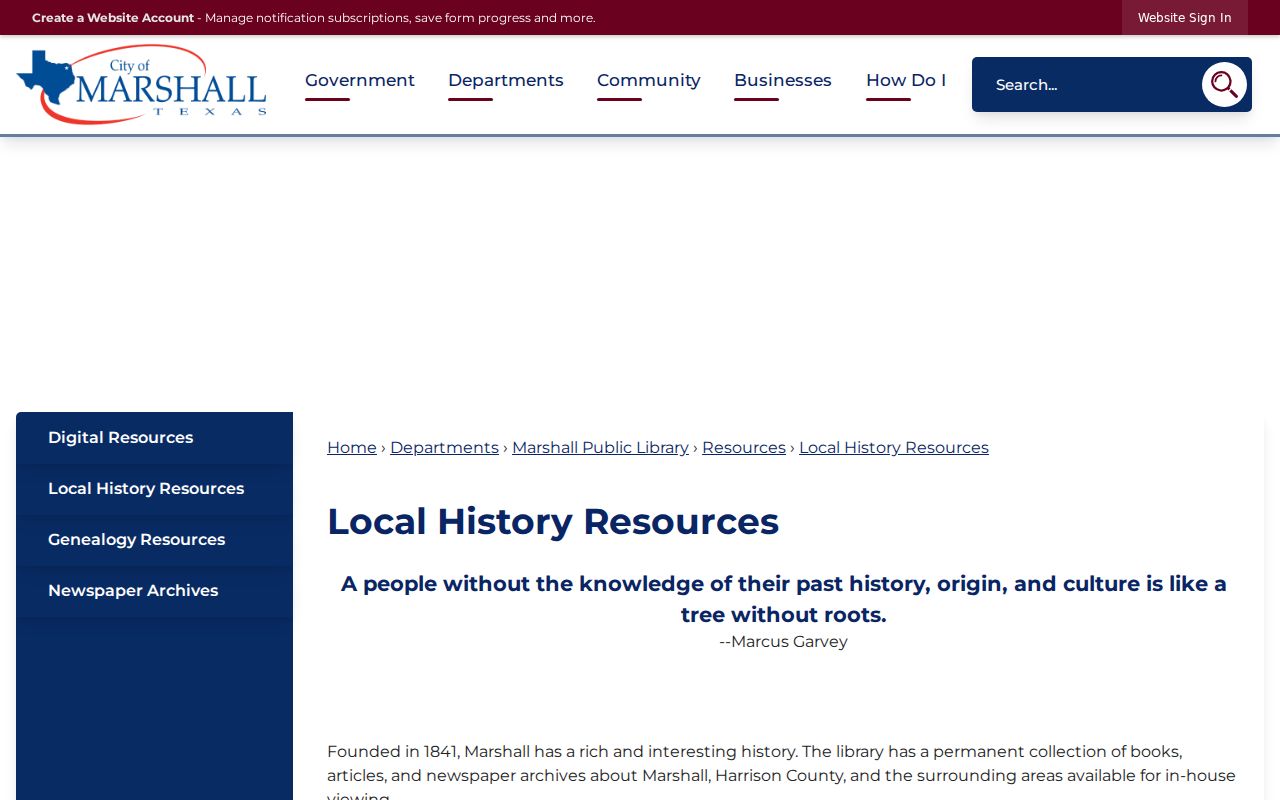
The local-history desk connects city-directory research to newspapers and maps when a directory year is missing or an address has changed form.
Marshall Museum Directory Lead
An SFA heritage-center house study supplies a useful local example: it cites an 1893 Marshall directory in Harrison County Historical Museum archives while identifying a historic resident connected with the Arnot House. That is tangible evidence that a directory volume can tie a person to a historic building in Marshall. It does not establish the complete contents, publisher, or page run of that 1893 volume. Preserve that distinction when using an archive reference in family history.
The museum's Inez Hatley Hughes Historical Research Center holds photographs, documents, books, and artifacts, and it partners with Portal to Texas History. Its collection can add context to names found in a directory, especially for local families, veterans, civic events, and historic addresses. Ask for the document, photograph, or catalog record connected to the question instead of assuming a broad online name index exists.
Harrison County Historical Museum is the documented research-center route for the 1893 directory context and related Marshall material.
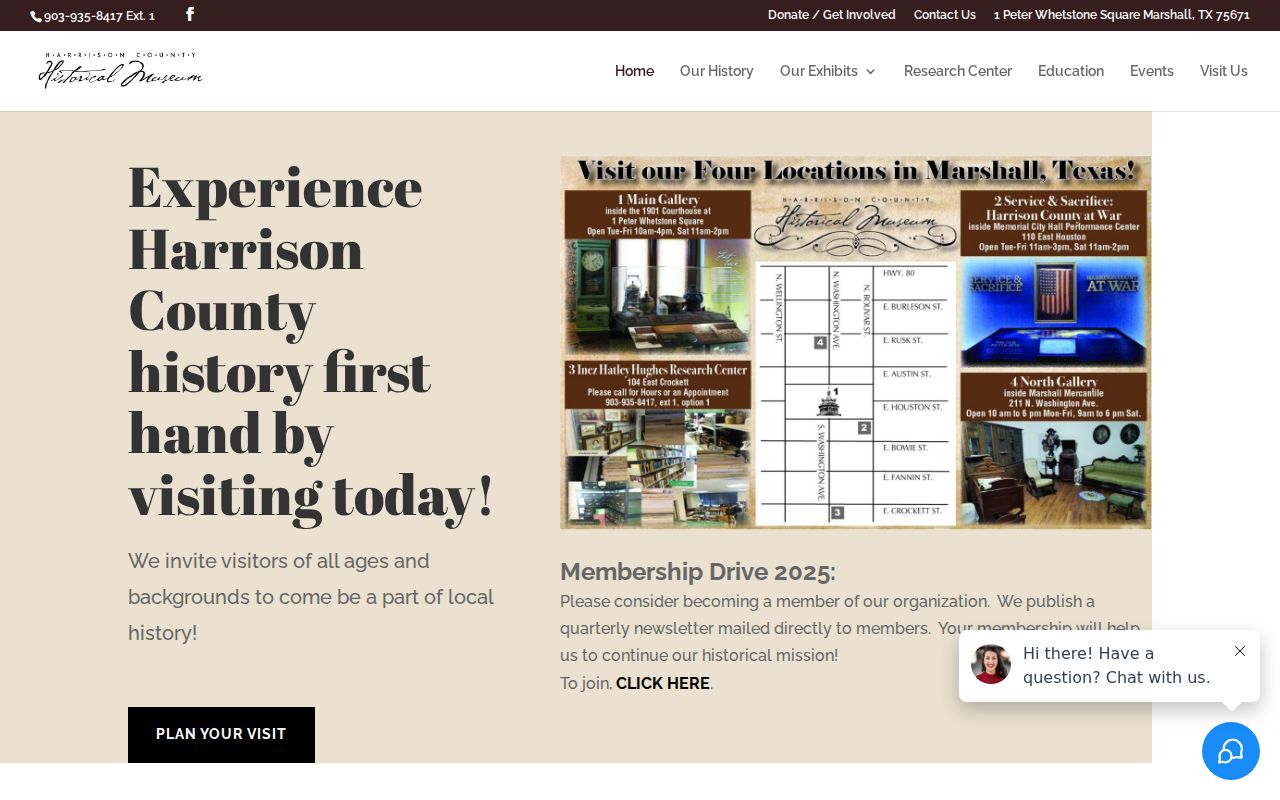
The museum provides an archive alternative when an old Marshall city directory is not on a library shelf or a digitized collection.
Tracing Marshall Directory Households
Use each Marshall city directory as one dated checkpoint. Begin with the closest confirmed name and year, then move one edition at a time in either direction. Record every address change, spelling change, and household notation. Pair a directory year with the nearest released federal census, then test the address against a newspaper, obituary, parcel record, or deed. Federal census household data is released through 1950 under the 72-year rule, and older street numbers may not match a modern address exactly.
- Find the first confirmed directory appearance and photograph or transcribe the title-page details with the entry.
- Check the next available edition for the same name, initials, spouse notation, or address.
- Use a reverse or criss-cross listing only when its existence for that volume is confirmed.
- Pair the closest directory entry with a released census household and a local newspaper search.
- Use the legal property trail only when ownership needs checking, because an occupant and owner can be different people.
A person who disappears may have moved, died, changed a name, entered an omitted household, or simply been missed by that edition. For a current parcel record rather than a historical shelf search, use the Marshall by-street directory route and preserve the address evidence separately.
Marshall City Directory Gaps
Marshall city-directory research has useful anchors but also real limits. No authoritative first or last printed year was found. No complete reverse-directory run, publisher sequence, or fully inspected entry model was verified. The absence of a digitized scan does not prove a volume never existed, and a catalog mention is not proof that a nearby library can supply it. These limits make the access chain important: library reference desk, museum research center, TSLAC holdings, Portal browsing, newspaper databases, and county records when a legal connection is needed.
Marshall's records history explains why cross-checking matters. The city was founded in 1841 and became the county seat in 1842. Harrison County's online historical deed indexes have their own separate spans, while city directories have a different and incomplete survival pattern. Directory research works best as a dated household trail, not a universal roster.